



What vibe coding actually is, and where it stops working
A plain definition, what the workflow looks like in practice, the five ways it breaks, what it costs, and the honest line between what you can ship with it and what you cannot
 Denis Romanovshipped products this way and collected the failures
Contents13 sections
- The definition, without the hype
- How it differs from no code builders
- What the loop actually looks like
- Where it stops working
- The line, stated plainly
- What it costs
- What you still have to learn
- How to tell a good session from a bad one
- Does the model actually understand what it wrote
- The three prompts that carry most of the weight
- Will this still work when the models change
- Common questions
- Where to start tonight
Short version: vibe coding is building software by describing what you want in plain language and letting a model write the code. You stay the author of the product and decide what goes in it. You do not spend a year learning syntax first
That definition is the easy part. The useful part is knowing where the method holds and where it falls apart, because it does fall apart, and always in the same five places
The definition, without the hype
Andrej Karpathy named it in February 2025, describing a way of working where you talk to the model, accept what it writes, and mostly stop reading the code line by line. The name stuck because it described something people were already doing quietly
Source: Andrej Karpathy named the term in a post on X, February 2025
Strip the marketing and you get three properties
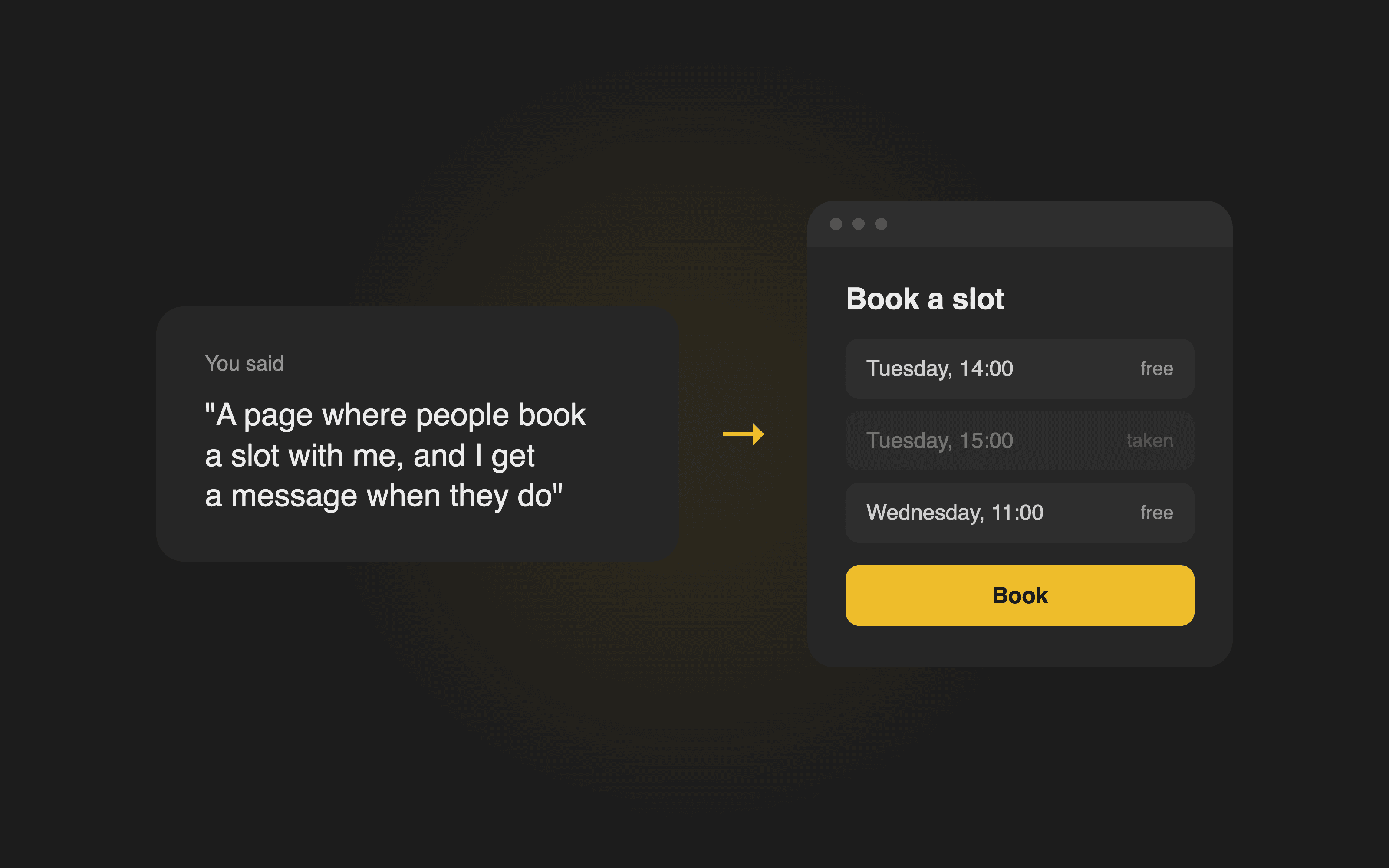
You describe outcomes, not steps. Not "add a flex container with 40px gap", but "these blocks are cramped, give them room"
The model writes and edits the files. Not snippets you paste. Actual files in an actual project
You judge the result by running it. The browser, the terminal output, the bot replying in the chat. Running the thing is the review
What it is not: a no code builder. Builders give you blocks and a ceiling. Vibe coding gives you a real codebase you own, with all the freedom and all the responsibility that implies
How it differs from no code builders
They get confused constantly, and the difference decides which one you should pick
| No code builder | Vibe coding | |
|---|---|---|
| What you assemble from | the blocks they give you | anything you can describe |
| Ceiling | the roadmap of their product | your own understanding |
| What you own at the end | an account | a codebase and a skill |
| Getting out | export the text, rebuild the rest | move the folder |
| Good for | one page you never touch again | anything you will keep changing |
A builder is genuinely the better answer when the site is needed tomorrow, will never change, and does exactly what the builder already does. That case is real and more common than people in this field admit
Everything else favours owning the code, and the advantage compounds. The first project takes an evening. The second takes two hours, because the understanding transfers and a builder account does not
What the loop actually looks like
An honest walkthrough of an evening, because the abstract description hides where the time goes
You open a terminal in an empty folder and run git init. Then you describe the thing: what it is, who opens it, what happens when they do, what it must not do. Three or four sentences, specific
The agent writes files. You open the result and look at it. Something is wrong, because something always is. You describe the one thing that is wrong. It fixes it. You save
git add -A && git commit -m "landing renders, form does nothing yet"Then you repeat that loop forty times. That is the whole method. The skill is not in the prompts, it is in noticing what is wrong and describing it in one sentence
Roughly eighty percent of the evening goes into decisions and text, not code. People are surprised by this every single time
Where it stops working
Five failure modes. All five are predictable, which means all five are manageable
The model invents things that do not exist
It will confidently import a library that was never published, or call a method that does not exist in the version you have. It looks right: correct naming, correct shape, and nothing to actually call
Catch it by opening the project page of anything unfamiliar. Thirty seconds, and it saves an hour of debugging a thing that cannot work
Its knowledge of any API is frozen and slightly stale
Interfaces change. A model trained months ago writes the old call with total confidence. This is invisible in review and only shows up at runtime, and the error text rarely points at the real cause
The fix is not a better prompt. It is you handing the model current documentation: paste the page, or point it at the docs
One edit breaks something that worked yesterday
You ask for a button change, it touches a neighbouring file, and login stops working. Nobody notices until someone tries to log in
This is not solved with prompting. It is solved with version control and the habit of saving after every working step. Then a rollback costs one command instead of an evening
The project outgrows what the model can hold
At ten files the model sees the whole project. At a hundred it sees a slice, edits that slice, and has no idea what it contradicts elsewhere. Fixes start fighting each other
Everyone hits this, at a different size, and sooner than expected. The workaround is a short project description you keep in a file and hand over at the start of each session: what lives where, what the rules are, what must never be touched
Security and money are not free
The model does not think about consequences by default. It will happily put a payment key in a file that ships to the browser, or trust a price that arrived from the client instead of the price list on the server
Nothing about that is exotic. It is the expected outcome of shipping payments without once asking what an attacker would try
The line, stated plainly
Things this method genuinely ships: landing pages that take payments, internal dashboards, Telegram and Slack bots, scrapers and reports, small SaaS with a few hundred users, anything where you are the only developer
Things it does not ship on its own: systems where a bug costs someone their money or their health, anything with real concurrency and real load, code that a team of ten will maintain for five years
The boundary is not the size of the code. It is the cost of being wrong
What it costs
A paid plan on one of the coding agents, twenty dollars a month at the entry tier, with higher tiers at a hundred and two hundred. Hosting is free until you have real traffic. A domain is about fifteen dollars a year
So around twenty five dollars a month to work seriously. The expensive part is not money, it is the evenings
What you still have to learn
Not syntax. Four other things, and they take a few evenings, not six months
How to go back. Version control, one commit per working step, and how to read what changed
Where your machine ends and a server begins. Why it works locally and not for anyone else, and what an environment variable is for
Why a password never goes in the code. And what to do when it already did
What happens when two people use it at once. The single most common reason a demo that worked falls over in public
Skip these and you will ship things that work exactly once, on your laptop, for you
How to tell a good session from a bad one
A good session has short steps and frequent saves. You know what changed and why. When something breaks you can name the last thing you did
A bad session looks like this: you ask for a fix, it does not work, you ask again, it half works, you ask a third time, and now three files have changed and nothing runs. The project is a pile
The rule that prevents it: after two failed fixes, stop asking. Roll back to the last working state and describe the task again, differently. The third attempt from a broken state has close to zero chance, and every attempt after that makes the pile bigger
Does the model actually understand what it wrote
No, and it does not need to for this to be useful. But that changes how you review
The model is confident regardless of whether it is right. Confidence carries no information here. So you cannot use its tone as a signal, and you should not ask "is this correct", because the answer is always yes
Ask differently. "Show me where this breaks with ten people using it at once" produces noticeably better output than "check this code". So does "what did you assume that I did not tell you"
The three prompts that carry most of the weight
Not a library of magic phrases. Three shapes that consistently produce better output than the alternative
Constraints instead of adjectives. "One accent colour, two text sizes, no icons" beats "make it look modern". Constraints remove the safe average answer, adjectives add to it
The failure question. "Where does this break with ten people at once" beats "is this code good". The first has a real answer, the second has a polite one
The assumption question. "What did you assume that I did not tell you" surfaces the decisions the model quietly made for you, and those decisions are where the surprises live
Everything else people sell as prompt engineering is mostly this, restated
Will this still work when the models change
The tools will change. The four things above will not, because none of them are about a particular model. Version control, environments, secrets and concurrency were true before any of this and will outlive whatever replaces it
What ages fastest is the tool names. What ages slowest is knowing what you are building and why
Common questions
Do I need to know how to code. To ship the first thing, no. To keep it running, you need the four things above. That is a few evenings, not a career change
Can I use the free tier. For the first steps yes. Serious work runs into limits quickly, and the twenty dollar tier is where most people settle
Is the code any good. Usually fine for its size and worse than it looks at scale. That is exactly why the boundary above matters more than the code quality debate
What if I do not understand what it wrote. Then ask it to explain that file in plain language before you accept it. Not understanding is fine early on. Not knowing that you do not understand is what causes damage
Will this replace developers. It replaces the part where a simple thing needed a developer for three weeks. Everything that was hard is still hard, and the hard part was never typing
Where to start tonight
Three steps, twenty minutes, no reading required
Create a folder and run git init in it. Write one sentence about who opens the thing and what happens when they do. Hand that sentence to an agent and look at what comes back
Everything after that is edits, and edits go one at a time
Read next