



Learning to build with AI: what to study, and how to spot a course that teaches nothing
What a year of search data says about who still buys programming courses, what is actually worth learning, what to leave for later, and four questions that separate a real course from a rewritten manual
 Denis Romanovbuilt this site and the course the same way this article describes
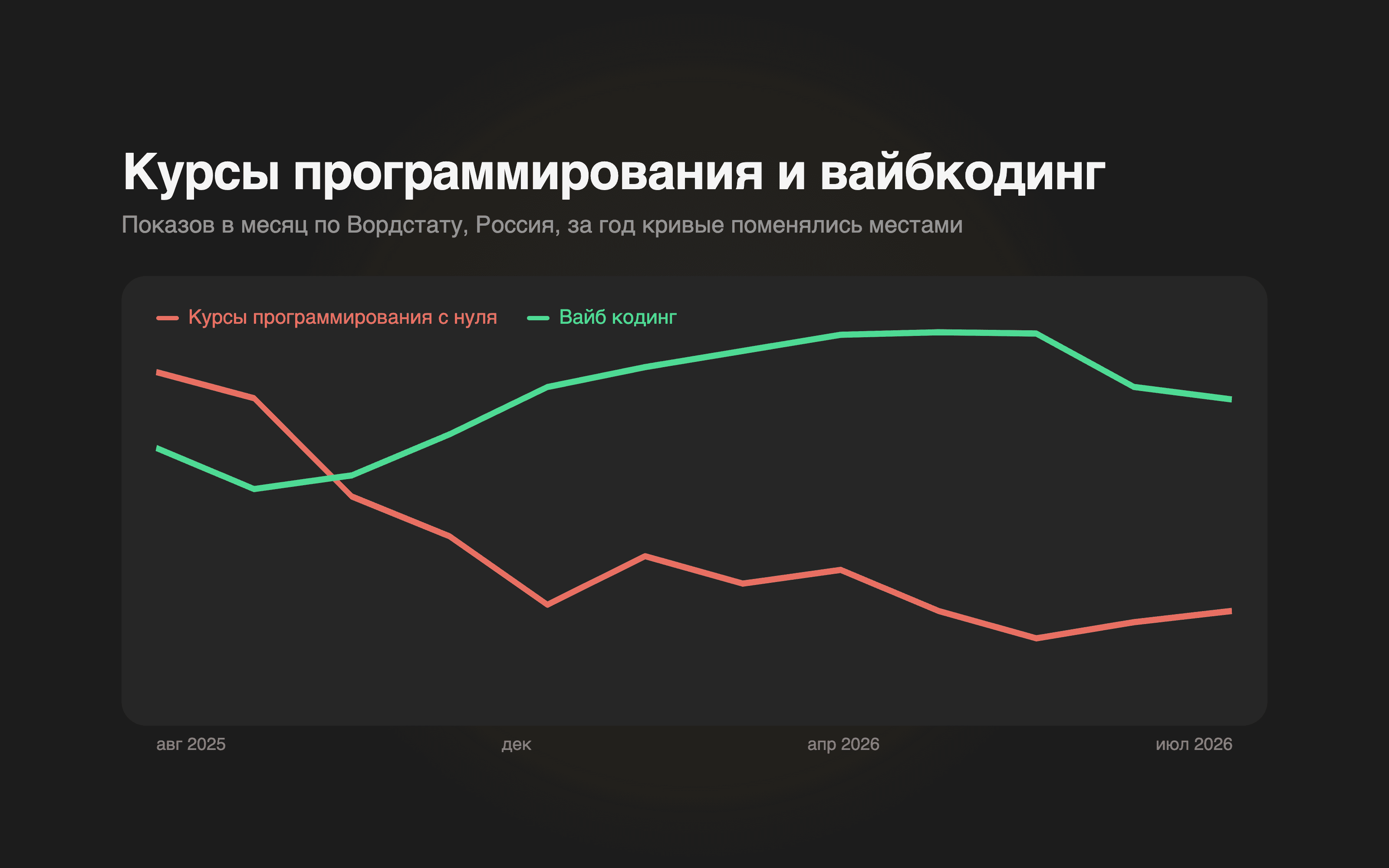
Over one year, searches for «programming courses from scratch» in Russia fell from 10 252 a month to 3 997. Searches for «vibe coding» rose from 8 000 to 11 382 over the same period. In autumn 2025 the two curves crossed
That does not mean programming stopped mattering. It means people stopped buying a way into the profession and started buying a way to make their own thing
We measure the Russian market because that is where we sell, and the numbers below are ours. The pattern behind them is not local
Source: Yandex Wordstat, Russia, monthly from August 2025 to July 2026
What the measurements show
| Month | Programming courses from scratch | Vibe coding |
|---|---|---|
| August 2025 | 10 252 | 8 000 |
| October 2025 | 6 895 | 7 214 |
| December 2025 | 3 712 | 9 814 |
| March 2026 | 4 705 | 13 323 |
| July 2026 | 3 997 | 11 382 |
The first query lost two and a half times its volume. The second gained half again and held
A third number explains both: «learning neural networks» sits at 24 445 a month, more than the other two together
Why this happened
There used to be a year of study, or a large invoice to an agency, standing between «I want a site» and «the site works». There was no third option, so people went to study, because the alternative cost more
Now an evening and a twenty dollar subscription stand between those two points. A year of study stopped being the only road, and demand moved to the shorter one
This does not abolish the profession. Developers did not go anywhere, and hard things are still built by them. But someone who only needed a page that takes payments no longer enters a profession to get one
So is studying pointless now
No, but the subject changed
There is a common belief that with a model you need to understand nothing at all. It survives until the first breakage. A model writes broken code confidently, and explains why that code works just as confidently. Telling those apart without understanding is impossible
Here is the honest line. Without studying you will build the first thing. From the second week the edits begin, and that is where knowledge is needed: not to write code, but to see what you have been handed
What is actually worth learning
The order matters: it runs from what you need on the first evening to what you need in the third week
Stating a task in words. This is the main skill and it is not about code at all. The difference between «build me a site» and a page of text saying what the result is, what it consists of and what not to do, is the difference between garbage and a result. This takes the longest to learn, because there is no correct answer here, only practice
Reading rather than writing. You do not need to write a function from scratch. You need to read what the model wrote and notice that it queries the database inside a loop, or keeps money in a floating point number
Knowing what a product is made of. What a database is and why it lives apart from the code. What happens between a button press and money leaving an account. Where a key lives and why it can never go into a browser. This is not programming, it is structure, and it is explained in one evening
Undoing what you broke. Version control. The single skill that separates «an edit broke the working site, evening lost» from «rolled it back in thirty seconds»
Checking. How to be sure it works somewhere other than your own laptop. It is boring, and it is exactly where beginner projects fall over
What to leave for later
Algorithms and data structures. They are asked about in interviews, not while building your own product. If you are not applying for a job, they can wait
Choosing a language. The argument about what to learn first has eaten more evenings than any real task. Take whatever most examples for your problem are written in
Beautiful architecture. Until a product has users, any architecture is good enough. Rewriting a hundred lines is cheaper than half a year of design
Three models at once. Take one and carry it to a result. You can compare when you have something to compare
How to spot a bad course
Ten minutes on the course page and four questions. They work against us too
Is a result shown, or only a syllabus. Twenty modules tell you nothing. Tell me what will open on a link at the end of my first evening
Is it written down what breaks. A course where everything works first time was written by someone who never built anything harder than the example in the manual. Real work has a «why it did not start» section and it is long
Are there numbers, and where from. «Thousands of students» is not a number. A number is a measurement with a source and a date that you can check yourself
What is promised about money. Any income promise is a warning sign. A course can give knowledge and tools, the outcome depends on what you do with them, and an honest author writes exactly that
Ask yourself a fifth question: how many hours is this. If no hour count is stated anywhere, the author never counted
What it costs to start
One subscription to one agent. As of publication that is 17 dollars a month billed annually, or 20 monthly, for Claude Code; 8 dollars for Codex Go; nothing for Gemini CLI on the free plan
Any computer younger than seven years will do. No special hardware: the model does not run on your machine
How long it takes
A first result that opens on a link: one evening. That is not a marketing figure, it is step five of our course, and people reach it in an evening
The confidence to take on an unfamiliar task without dread: thirty to forty hours of practice. Stretch it over a month, two months, half a year. The calendar is not what matters, the count of finished things is
Nobody needs a year, the way the old scheme required
What will not happen
You will not stop getting stuck. You will always get stuck, the places just move: first it will not start, then it will not deploy, then it works for you and not for other people
The model will not replace understanding. It replaces typing, and the decisions stay yours
There will be no diploma and no line on a resume. There will be a link you can show, and in your case that may be worth more
Where to start tonight
Take a real task, not a practice one. A real task is one whose result you will show a living person tomorrow: a page for your own business, a bot that answers for you, a table that counts what you now count by hand
A practice task teaches nothing: it works the first time, and all the learning is in what happens when it does not
So what have you been putting off because it felt like a year of study had to come first?
Read next